

Social media in Egypt is not like social media anywhere else. The audience is young (median age under 25), mobile-first, bilingual, culturally specific, and highly engaged. What works in the US or Europe does not automatically translate. And what worked in Egypt two years ago does not automatically work today.
This is the 2026 playbook for brands that want to win on social media in Egypt. It covers platform strategy, content frameworks, production models, and the criteria for choosing the right social media agency in Cairo or anywhere in the country.
The Platform Landscape: Where Egyptian Audiences Actually Are
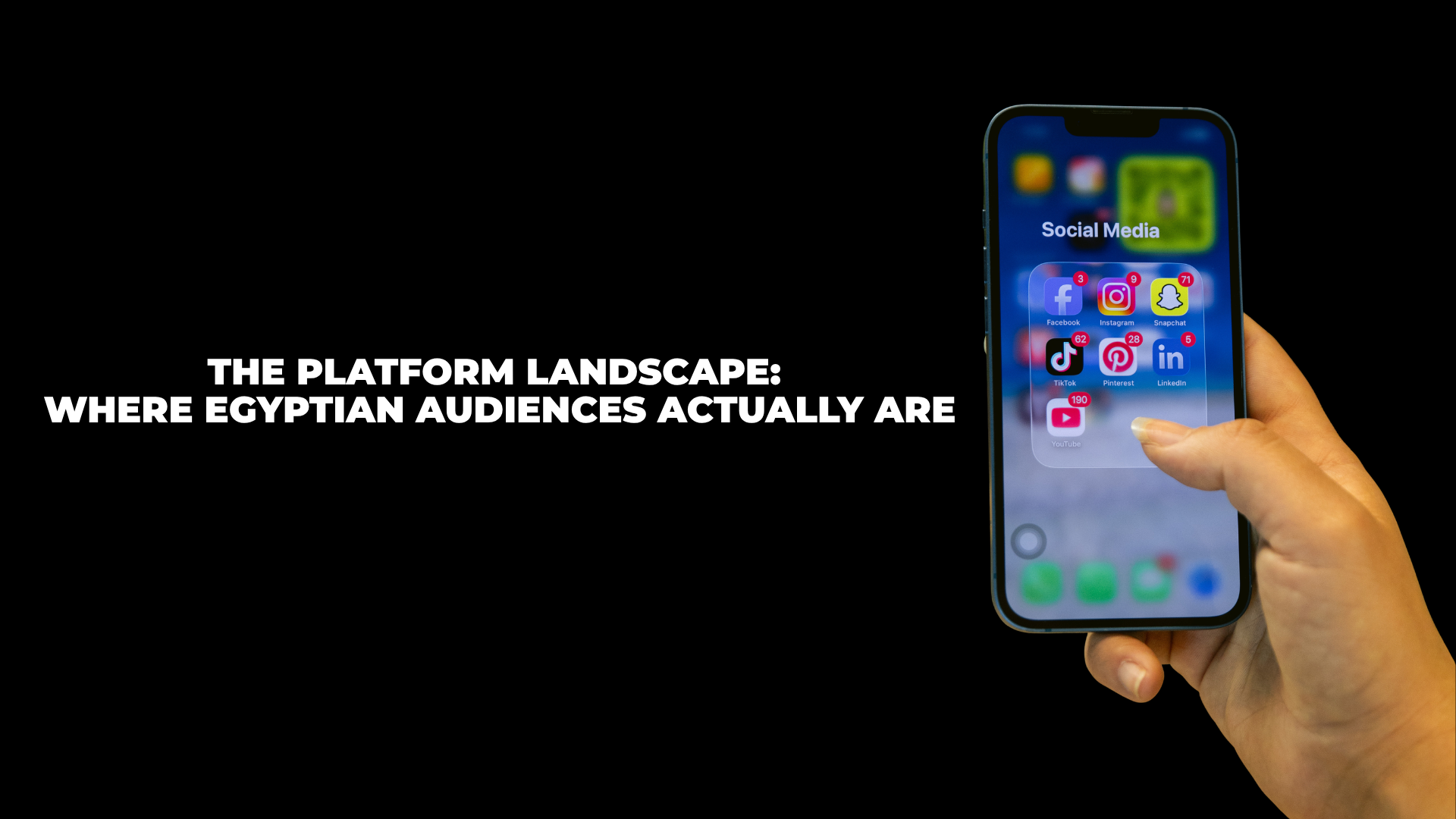
Instagram remains the most important platform for brand building in Egypt. The audience skews 18-35, is highly visual, and responds well to polished content. But the rules of engagement have changed. Static posts are losing ground to Reels, Stories, and carousel formats. Brands that are still posting single-image content with long captions are being outperformed by those creating short-form video and interactive formats.
TikTok has become the fastest-growing platform in Egypt, particularly for brands targeting consumers under 30. The algorithm favors authentic, entertaining content over polished production, which means brands willing to be creative and fast have a significant advantage. TikTok is no longer experimental. It is essential.
Facebook still has the largest user base in Egypt, but engagement rates have declined significantly. Its primary value is now as a distribution channel (cross-posting from Instagram), a customer service platform (Messenger), and an advertising vehicle. For organic content strategy, Facebook should not be your primary focus.
LinkedIn is emerging as a critical platform for B2B brands and professional services in Egypt. The audience is smaller but highly valuable: decision-makers, business owners, and senior professionals. Thought leadership content on LinkedIn generates the highest-quality leads of any social platform.
YouTube maintains its position as the second-largest search engine. For brands investing in educational content, product demonstrations, or long-form storytelling, YouTube is a long-term asset. Content published on YouTube continues to generate views and leads for months or years after posting.
Content Strategy: The Two-Pillar Framework
The most effective social media strategy in Egypt right now is built on two pillars: proving your value (what makes clients want to work with you) and proving your culture (what makes talent want to work for you). These two pillars serve different audiences but reinforce each other.
Pillar one focuses on results, case studies, client testimonials, thought leadership, and industry expertise. This content attracts potential clients and establishes credibility.
Pillar two focuses on team culture, behind-the-scenes content, career stories, and workplace values. This content attracts top talent and humanizes the brand.
The magic happens when both pillars work together. A potential client who sees your case studies and then sees your team culture thinks: ‘This is a company that does great work AND has great people.’ That combination is more persuasive than either pillar alone.
Production at Scale: The Weekly Content Engine
The biggest challenge for brands in Egypt is not knowing what to post. It is producing enough quality content consistently. The agencies that solve this problem use a systematic approach: the weekly content engine.
Here is how it works: every week, the content calendar is planned in advance based on the pillar framework. Content is produced in batches, not one piece at a time. Templates are used for recurring formats to speed up production without sacrificing quality. And everything flows through an approval process before going live.
The result is a consistent posting cadence of 15-20 pieces per week across all platforms, without burning out the team or sacrificing quality. This is the difference between brands that post sporadically and brands that dominate feeds.
Paid vs. Organic: Finding the Right Balance
In 2026, organic social media reach in Egypt is at an all-time low. Instagram organic reach averages 5-8% of followers. Facebook is even lower. This means that relying solely on organic posting is a losing strategy.
The smart approach is to use organic content as your testing ground and paid amplification as your scaling mechanism. Post content organically first. Identify what resonates based on engagement data. Then put paid budget behind the winners.
This approach is more capital-efficient than creating separate ‘ad creative’ and ‘organic creative.’ The content that performs organically with your existing audience is the best predictor of what will perform with a paid audience.
Allocate at least 30% of your total social media budget to paid amplification. Without it, even the best content will reach only a fraction of its potential audience.
Measuring What Matters
- Social media metrics can be misleading if you are tracking the wrong ones. Followers and likes are visibility metrics, not business metrics. Here is what to track instead:
- Engagement rate by platform (are people interacting, or just scrolling past?)
- Click-through rate to your website (is social driving actual traffic?)
- Lead generation volume (are social efforts producing business inquiries?)
- Content performance by pillar (which type of content drives the most value?)
- Share and save rate (the strongest signal that content is valuable to the audience)
Review these metrics weekly, not monthly. Social media moves too fast for monthly analysis. By the time you review monthly data, the trends have already shifted.
Measuring What Matters
The agency market in Egypt is crowded, and not all social media agencies are created equal. Here is what to look for:
First, look for a social media agency that understands the Egyptian market specifically. International playbooks need local adaptation. Cultural context, humor, language nuances (the mix of Arabic and English), and seasonal rhythms all matter.
Second, look for production capacity. An agency that produces beautiful content but only delivers 3 posts per week cannot serve a brand that needs 15-20. Ask about their production workflow and weekly output capacity.
Third, look for data integration. The best social media agencies in Cairo do not treat social as an isolated channel. They connect social performance to website analytics, CRM data, and business outcomes. Social media that does not connect to revenue is entertainment, not marketing.
Finally, look for a track record of consistency. Anyone can produce a viral moment. The real test is whether an agency can maintain quality and results month after month, quarter after quarter. Ask for 6-12 months of performance data, not just highlight reels.
The Egyptian social media landscape rewards brands that are consistent, culturally fluent, and data-informed. Find an agency that embodies all three, and you will outperform competitors who are still treating social media as an afterthought.