

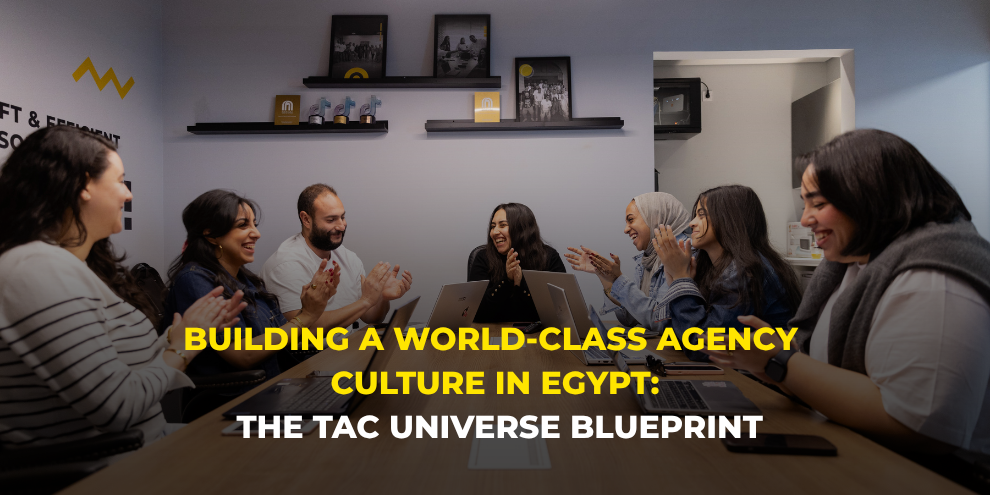
Agency culture in Egypt has a reputation problem. Long hours, low pay, high turnover, minimal growth opportunities, and leadership that treats people as interchangeable production resources. It is a reputation that many agencies have earned.
Building a different kind of agency was not an accident. It was a deliberate decision made over 14 years: to create an environment where talented people do their best work, grow their careers, and actually enjoy the process. That is not idealism. It is a business strategy. Because the best work comes from the best people, and the best people choose where they work.
This article documents the principles and systems behind TAC Universe’s culture. Not as a ‘look how great we are’ exercise, but as a blueprint for anyone who believes agency life can be better than the industry average.
Principle 1: Culture Is a System, Not a Vibe
Most agencies think culture means having a cool office and hosting occasional team outings. That is not culture. That is decoration.
Real culture is the set of systems, norms, and incentives that shape how people behave when nobody is watching. It is how decisions get made, how conflict gets resolved, how credit gets distributed, and how failure gets handled.
At TAC, culture is engineered through specific systems: structured onboarding that ensures new team members understand not just their role but the company’s values and operating principles. Weekly check-ins that surface problems before they become crises. Quarterly reviews that focus on growth, not just performance evaluation. And a governance framework that ensures consistency even as the team scales.
The insight: if you cannot describe your culture as a set of specific practices and systems, you do not have a culture. You have an accident.
Principle 2: Growth Is the Ultimate Retention Tool

The number one reason talented marketers leave agencies in Egypt is not compensation. It is stagnation. They feel stuck in the same role, doing the same work, with no clear path forward.
Solving this requires intentional career architecture. Every role at TAC has a defined growth path: what skills you need to develop, what milestones you need to hit, and what the next role looks like. This is not vague ‘we will promote you when you are ready.’ It is a documented, transparent system.
Beyond role progression, growth means continuous learning. The agency invests in training, certifications, conference attendance, and cross-functional exposure. A media buyer who wants to understand strategy gets the opportunity. A designer who wants to learn motion graphics gets support.
The result: people stay because they are growing. And people who are growing do better work.
Principle 3: Transparency Builds Trust
One of the most corrosive elements in agency culture is information asymmetry: leadership knows things the team does not, decisions happen behind closed doors, and people feel like they are operating in the dark.
The antidote is radical transparency. At TAC, the team has visibility into company performance, client health, strategic direction, and operational challenges. Not because everyone needs to be involved in every decision, but because trust requires context.
When people understand why decisions are made, they are more engaged, more aligned, and more resilient when things get tough. And in agency life, things always get tough.
Principle 4: Results and Culture Are Not Trade-offs

The most damaging myth in the agency industry is that you have to choose between delivering great results and having a great culture. That treating people well comes at the expense of performance.
The opposite is true. Teams that feel valued, supported, and challenged produce better work than teams that are burned out, underappreciated, and operating in survival mode. This is not opinion. It is observable in client satisfaction scores, retention rates, and creative output quality.
The agencies that burn through people are not more productive. They are more wasteful. They lose institutional knowledge with every departure, spend months onboarding replacements, and deliver inconsistent quality because the team is always partially new.
Investing in culture is investing in performance. They are the same thing.
Principle 5: Celebrate Loudly, Correct Privately
How an agency handles recognition and feedback says everything about its culture.
Celebrations should be public, specific, and genuine. When someone does exceptional work, the entire team should know about it. Not generic ‘Employee of the Month’ awards, but specific recognition: ‘Salem’s media buying optimization on the Naqla campaign increased ROAS by 340%. That is world-class work.’
Corrections should be private, constructive, and forward-looking. Nobody should be criticized in front of their peers. Feedback should focus on behavior and outcomes, not personality. And every correction should end with a clear path to improvement.
This simple asymmetry, celebrate loudly and correct privately, creates an environment where people feel safe to take risks and proud of their achievements. That is the foundation of creative courage.
Principle 6: Work-Life Integration, Not Balance

The concept of work-life balance implies that work and life are opposing forces that need to be kept in equilibrium. In reality, for people who are passionate about their work, the goal is not balance but integration: building a life where professional growth and personal fulfillment reinforce each other.
What this looks like in practice: flexible working arrangements that accommodate real life. Mental health days that are actually encouraged, not just listed in a policy. Workload management that prevents chronic overtime. And respect for personal time, especially during evenings, weekends, and holidays.
The agency industry has a burnout problem. Solving it requires not just individual wellness initiatives but structural changes to how work is planned, allocated, and managed.
The Business Impact of Culture
Culture is not a soft, unmeasurable concept. Its impact is visible in hard metrics: employee retention (how long people stay), employer brand strength (how many qualified applicants you attract per opening), client retention (stable teams deliver better client results), creative quality (engaged people produce better work), and operational efficiency (low turnover means less time spent hiring and onboarding).
Building a world-class agency culture in Egypt is not easy. The market pressures are real: tight margins, demanding clients, and a competitive talent market. But the agencies that solve the culture equation will win the talent war, and winning the talent war is how you win everything else.